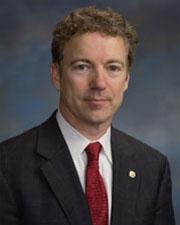
Rand Paul
Since the current Congress began on January 3, 2025, Paul has a recorded vote on 38 laws that passed.
This record covers laws that passed. Votes on bills that did not become law are not included yet.
The record in plain language
Of the 118 laws passed since January 3, 2025, 38 came to a recorded vote in the Senate while Paul is a member. The rest passed the Senate by voice vote or without objection, which records no individual votes.
Paul votes Yes on the Laken Riley Act on immigration detention; the HALT Fentanyl Act; the Rescissions Act of 2025, which cancelled about $9 billion in approved spending; and the Secure America Act, a 2026 budget law.
On funding the government, Paul votes No on the March 2025 full-year funding law; the November 2025 law that ended the 43-day shutdown; the January 2026 funding law for science, energy, Interior and the EPA; the February 2026 funding law for a further group of agencies; and the September 2026 funding extension.
Paul votes No on the One Big Beautiful Bill Act, the 2025 tax and spending law; the GENIUS Act on stablecoins (digital tokens pegged to the dollar); the defense policy law for fiscal year 2026; the 21st Century ROAD to Housing Act; and the Russia and Iran sanctions law.
Congress cancelled 24 federal rules by recorded vote in the Senate in that time. Paul votes to cancel 23 and against cancelling 0, and did not vote on 1. The rules Paul votes to cancel come from: Interior: Bureau of Land Management (7), Environmental Protection Agency (6), Energy (4), Consumer Financial Protection Bureau (2), Treasury: Comptroller of the Currency (1), Interior: National Park Service (1), Treasury: Internal Revenue Service (1) and Interior: Ocean Energy Management (1).
On all 27 Yes votes Paul votes the same way as most Senate Republicans. On all 10 No votes Paul votes differently from most of them.
Paul did not vote on the law that cancels a District of Columbia law that changed how D.C.'s income and business taxes follow federal tax rules.
Votes on laws that passed
Authorizes and expands sanctions and tariffs on Russia and extends existing sanctions on Iran.
Keeps the federal government funded at about last year's levels through December 11, 2026.
A package of housing measures intended to increase the supply of homes.
Gives the Department of Homeland Security extra money for border and immigration enforcement, in seven amounts that add up to $69.545 billion.
Cancels a federal order that had closed about 225,000 acres of national forest in northeastern Minnesota, near the Boundary Waters, to new mining leases for 20 years.
Cancels a District of Columbia law that changed how D.C.'s income and business taxes follow federal tax rules.
Full-year fiscal 2026 funding for a further group of federal agencies.
Full-year fiscal 2026 funding for the Commerce and Justice Departments, science agencies, energy and water programs, the Interior Department and the EPA.
The annual defense policy law.
Cancels a land agency decision that limited oil and gas leasing on the coastal plain of the Arctic National Wildlife Refuge.
Cancels a land agency plan for northeastern Wyoming that ended new federal coal leasing in the Buffalo area.
Cancels a land agency plan for central Alaska that set aside large areas for conservation and limited development.
Cancels a land agency plan for federal lands in North Dakota that limited where coal, oil and gas could be leased.
Cancels a land agency plan for eastern Montana that ended new federal coal leasing in the Miles City area.
Cancels a land agency plan that limited oil and gas leasing in the National Petroleum Reserve in Alaska.
Ends the 43-day government shutdown of fall 2025.
Cancels about $9 billion that Congress had already approved: roughly $8 billion in foreign aid and about $1 billion for public broadcasting.
Creates the first federal rules for payment stablecoins (digital tokens pegged to the dollar).
Permanently places fentanyl-related substances in the most restricted drug category, which carries the strictest criminal penalties, and eases registration for researchers who study them.
Cancels an EPA rule that had stopped certain large sources of toxic air pollution from being moved into a less strictly regulated category.
Cancels a bank regulator's rule that changed how proposed bank mergers are reviewed, restoring the earlier, faster process.
Cancels the EPA approval that let California set stricter smog-pollution limits for heavy-duty truck engines.
Cancels the EPA approval that let California phase out sales of new gasoline-only cars by 2035.
Cancels the EPA approval that let California require truck makers to sell a rising share of zero-emission trucks.
Cancels an EPA rule that tightened limits on toxic air emissions from tire manufacturing plants.
Cancels a National Park Service rule that restricted where off-road vehicles could drive in Glen Canyon National Recreation Area.
Cancels a rule that would have put the largest digital payment apps under the consumer bureau's regular supervision.
Cancels a consumer bureau rule that would have limited overdraft fees at the largest banks and credit unions.
Cancels an Energy Department efficiency standard for commercial refrigerators and freezers.
Cancels an Energy Department rule on how appliance makers certify, label and report the energy use of their products.
Cancels an Energy Department efficiency standard for walk-in coolers and freezers used by stores and restaurants.
Cancels an Energy Department efficiency standard for tankless gas water heaters.
Cancels an IRS rule that would have required decentralized finance platforms to report their customers' digital asset sales the way stockbrokers do.
Funds the federal government through September 30, 2025, mostly at the prior year's levels, with more for defense and less for non-defense programs.
Cancels a rule that required offshore oil and gas leaseholders to submit archaeological surveys of the seabed before drilling.
Cancels an EPA rule that set up how oil and gas facilities would be charged a fee for excess methane emissions.
Requires immigration authorities to detain non-citizens without legal status who are charged with, arrested for or convicted of theft-related crimes, assaulting a police officer, or crimes causing death or serious injury.
What this member says about laws and orders
This section has two lists: statements in the official record, and excerpts from this member’s own press releases. Together they name 1 executive order.
From the official record
Statements from the official record: Not checked yet. A statement appears here after a person reviews our account of the law or order it is about.
From this member’s press releases
From a secondary sourceThese are excerpts from press releases on this member’s official website that name a law or an executive order. We save a copy of each one.
“News item” marks an item the site publishes outside its press release pages.
1 excerpt
-
News item Paul and Wyden Introduce Bipartisan Resolution to Reassert Congressional Authority Over Tax Policy
“The resolution would end the emergency declared in Executive Order 14257, which enabled tariffs of up to 49% on a wide range of imported goods. American consumers will face higher costs, and U.S. manufacturers and farmers will be hit by retaliatory tariffs from foreign governments once the tariffs go into effect.”
Member-requested spending
Member-requested spending: none found in the 4 laws read so far.
Laws read: Public Law 119-37, Public Law 119-74, Public Law 119-75, Public Law 119-86.
Online ads
From a secondary sourceThese are records from public ad libraries, for advertisers tied to this member. We show an ad only after we save our own copy of it.
RAND PAUL FOR US SENATE Google Ads Transparency Center
Evidence for the tie: The library lists FEC committee number C00496075 for this advertiser, and the FEC committee file names this member as that committee’s candidate.
The library lists 4 ads by this advertiser since January 3, 2025.
We have not saved our own copy of these 4 ads yet, so this page shows none of them. Cause: Google’s data file carries no words, picture or video of the ad.
Read from Google Ads Transparency Center, its data file of October 6, 2026. Meta Ad Library: Not started. An ad counts when the library last shows it on or after January 3, 2025.
Campaign money
Campaign money:Not checked yet
No campaign money record is saved for this official yet.
Where this comes from
We saved our own copy of each official Senate vote file listed here before writing this page. A code beside a file is its fingerprint, a short code that changes if the file's contents change.